
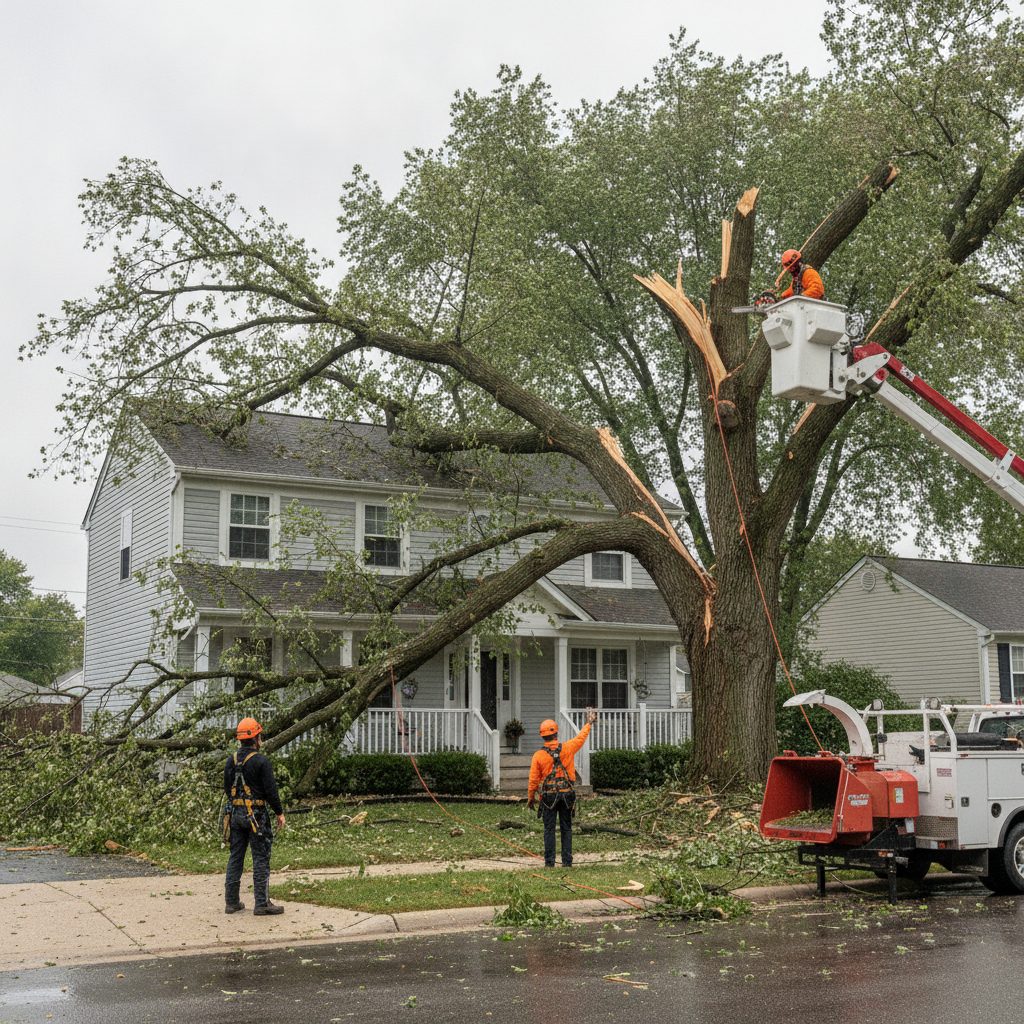
A branch cracks overhead at two in the morning, a limb crashes across the driveway, or a trunk leans toward the bedroom window after a violent storm rolls through. In moments like these, most people reach for their phone and search for emergency tree service Blue Island Illinois, hoping someone answers fast. But speed is only one piece of the puzzle. The choices you make in the first hour after a tree emergency can determine whether you face a manageable cleanup or a five figure insurance headache.
Here is the uncomfortable truth: most property owners only think about trees when something goes wrong. They have no vetted contact, no understanding of what their homeowner policy covers, and no plan for who is responsible when a neighbor’s oak lands in their yard. That lack of preparation is exactly where costly mistakes happen, from hiring unlicensed crews to accepting inflated quotes under pressure.
Whether you run a small business with a parking lot lined with mature trees, manage rental properties, or simply own a home on a shaded street, this guide covers what most articles skip. We will walk through what actually counts as an emergency, the hidden risks near utility lines, how insurance treats storm damage, what to ask before a crew touches your property, and how to prevent the next crisis before it starts. Think of it as the checklist you wish you had before the storm hit.
Emergency Tree Service in Blue Island: What Counts as an Emergency
Not every fallen branch qualifies as an emergency, and knowing the difference saves money and stress. A true emergency involves immediate danger to people, structures, or access. That includes a tree resting on a roof, a trunk blocking a driveway or public road, a limb tangled in power lines, or a large crack that suggests imminent collapse. If anyone could be hurt in the next few hours, treat it as urgent. For related information, see tree removal and care.
Situations that feel dramatic but can often wait a day or two include a downed limb in an open yard, a small tree leaning without roots lifting, or hanging branches over a fence line that are not near anything valuable. Calling a crew at midnight for these can mean premium after hours rates you did not need to pay. When in doubt, describe the situation clearly and ask a professional tree removal and care team to help you triage the risk before dispatching a full crew.
Emergency Tree Service in Blue Island, IL: Hidden Dangers Most People Miss
The obvious hazard after a storm is the tree itself. The hidden hazards are what surround it. Hanging limbs, often called widowmakers, can remain suspended in the canopy and drop without warning hours after the initial failure. Soil saturated by heavy rain can let a seemingly stable tree topple days later. Root plates that have lifted even slightly are a red flag. For related information, see tree care.
Another overlooked danger is tension. A bent or pinned trunk stores enormous energy, and cutting it incorrectly can cause it to spring violently. This is why amateur chainsaw work after storms sends so many people to the hospital every year. Professional crews use rigging, controlled cuts, and cranes when needed to release that tension safely.
Quality tree care also involves assessing what remains standing. A crew that only removes the fallen portion and ignores a compromised neighbor tree leaves you exposed to a repeat event. Ask for a full property walk through, not just a quick cleanup.
Emergency Tree Service Blue Island Illinois: Power Lines and Safety First
If any part of a fallen tree touches or even leans near a power line, stop. Stay at least thirty feet away, keep children and pets back, and call your utility provider and emergency services. Energized lines can electrify the ground, the tree, and even a vehicle parked nearby. No tree crew should approach until the utility confirms the line is de-energized or cleared. For additional service details and local availability, readers can visit our site.
Many homeowners assume a responsible emergency tree service Blue Island Illinois residents can call will simply show up and cut. In reality, qualified crews coordinate with utilities and refuse work near live conductors unless they hold specialized line clearance credentials. That refusal is a sign of professionalism, not unavailability.
After the lines are cleared, ask your crew how they will protect your service drop, meter, and fencing during removal. Documenting the scene with photos before work begins also protects you if disputes arise later about who damaged what.
Also keep a flashlight, a charged phone, and a short written list of emergency numbers where the whole household can find it, because outages often accompany the very storms that topple trees.
What to Do in the First Hour After a Tree Falls
The first sixty minutes set the tone for everything that follows. Start by making sure everyone is safe and accounted for. Move people and pets away from the damaged area, and do not walk beneath leaning or hanging limbs. If the tree has struck a structure, check for gas smells, water leaks, or exposed wiring before going back inside.
Next, document everything. Take wide shots and close ups of the tree, the damage, and any property affected. Include timestamps if your phone allows it. These images become the backbone of your insurance claim. Then contact a licensed crew, and if you want a reliable local option, you can visit our site to learn how professional responders handle urgent situations.
Avoid signing anything on the spot, and never hand over full payment upfront. A reputable company will provide a written scope, a price range, and proof of coverage before starting.
How to Spot a Storm Chaser Before They Cost You
After every major weather event, out of town crews flood the neighborhood knocking on doors. Some are legitimate, but many are not. Storm chasers typically offer low cash prices, pressure you to decide immediately, and vanish if something goes wrong. They often carry no insurance, which leaves you liable if a worker is injured on your property.
Warning signs include unmarked trucks, out of state plates, no printed estimate, refusal to show a certificate of insurance, and requests for large upfront deposits. Another telltale sign is a crew that recommends removing a perfectly healthy tree to inflate the job size.
A trustworthy company has a physical address, verifiable reviews, a business license where required, and a track record you can actually check. If a stranger shows up uninvited right after a storm, politely take their information and verify it independently before agreeing to anything.
Insurance Coverage: What Your Policy Actually Pays For
Insurance surprises are among the most common regrets after a tree emergency. Generally, homeowner policies cover tree removal when a tree falls on a covered structure, such as a house, garage, or fence, or blocks a driveway or access point. Coverage often has dollar limits per tree or per incident, and deductibles still apply.
If a tree falls and damages nothing, many policies pay little or nothing toward removal. Trees that die from disease or neglect may also be excluded, since insurers can argue the owner failed to maintain them. This is why regular inspection matters long before a storm arrives.
Call your insurer promptly, share your photos, and ask what documentation they require from the contractor. Keep every receipt. Some policies reimburse emergency measures taken to prevent further damage, such as tarping a roof, so ask about that too before you assume you are on your own.
Who Pays When a Neighbor’s Tree Hits Your Property
Neighbor disputes complicate emergencies fast. The general principle is that a healthy tree that falls during a severe storm is usually considered an act of nature, which means the damage to your property is typically handled by your own insurance, not your neighbor’s. However, if the tree was clearly dead, diseased, or previously flagged as hazardous and the owner ignored it, liability can shift.
Documentation again becomes critical. Photos of the tree’s condition before the event, written notices sent to the owner, and an arborist’s assessment can all strengthen your position. Having a professional evaluate whether the tree was visibly unhealthy gives you objective evidence.
Whenever possible, approach the conversation calmly and early. Many property owners will cooperate, especially when cost sharing for removal benefits both parties. When tension rises, consult your insurer or an attorney familiar with local property rules before taking action.
Questions to Ask Any Crew Before Work Begins
A short list of questions can protect you from nearly every common problem. Ask whether the company carries both liability insurance and workers’ compensation, and request a copy of each certificate. Ask who will be on site, what equipment they will use, and how they plan to protect your lawn, driveway, and structures.
Clarify exactly what the quote includes. Does it cover hauling away all debris, chipping, and stump grinding, or only cutting the tree into pieces and leaving them behind? Is there a separate fee for after hours or emergency response? Surprises often hide in the fine print.
Finally, ask about certified arborists on staff and how long the company has operated locally. Longevity matters because it signals accountability. You can also check a company’s public profile, such as the listing for Prime Tree Care, Inc, to review feedback from other customers before you commit.
Typical Costs and Timelines at a Glance
Pricing varies widely based on tree size, access, hazards, and timing, so treat any national average with caution. The table below offers a general comparison of what drives emergency pricing so you can recognize a fair quote when you see one.
| Situation | Typical Response | Main Cost Driver |
|---|---|---|
| Tree on roof | Same day, crane or rigging | Equipment and structural risk |
| Tree blocking driveway | Within hours | Size and debris hauling |
| Hanging limb over home | Same or next day | Height and access |
| Fallen tree in open yard | Scheduled within days | Cleanup and stump work |
Preventing the Next Emergency Before It Starts
The cheapest emergency is the one that never happens. Routine inspection, ideally once a year and after major storms, catches problems early. Look for dead branches, fungus at the base, cracks in the trunk, leaning trees with exposed roots, and thinning canopies that signal decline.
Proper pruning also matters. Removing weak, crossing, or overextended limbs reduces wind resistance and lowers the chance of failure. Avoid topping, which weakens a tree and encourages fragile regrowth. Mulching, deep watering during dry spells, and avoiding soil compaction around the root zone all strengthen a tree’s natural defenses.
For business owners, a documented maintenance schedule has another benefit: it demonstrates due diligence if a tree ever causes injury or damage. A modest yearly investment in prevention is almost always smaller than a single emergency callout plus the property repairs that follow.
Seasonal Risks Every Property Owner Should Watch
The Midwest delivers a full spread of tree threats across the calendar. Spring brings thunderstorms and saturated soil that loosen roots. Summer adds straight line winds and microbursts that snap limbs without warning. Fall leaves and early cold snaps can load branches with weight, while winter ice and heavy snow stress even healthy trees.
Knowing the pattern lets you prepare. Schedule structural pruning in the dormant season when it is easier to see a tree’s framework, and check drainage around trunks before the spring rains arrive. After any severe weather alert, walk your property in daylight and look up before you look down.
Keep a simple record of which trees you have inspected and when. Over time, that log helps you spot slow changes, like a gradually leaning trunk or a canopy that thins year after year, long before they become urgent problems demanding a midnight phone call.
Your Next Steps
An emergency tree situation is stressful, but it does not have to be chaotic. The people who handle these moments best share a few habits: they know what truly qualifies as urgent, they keep distance from power lines, they document everything, and they verify a crew’s credentials before any saw starts running. They also understand their insurance and talk to neighbors early when property lines are involved.
The most overlooked lesson is that preparation beats reaction. Take a few minutes this week to walk your property, note any trees that look weak or overgrown, and save the number of a licensed, insured local company in your phone. When you already have a trusted contact, finding reliable emergency tree service Blue Island Illinois residents can count on becomes a quick call instead of a frantic search under pressure.
Remember the essentials: stay clear of hazards, photograph the damage, avoid door knocking storm chasers, ask for proof of insurance, and get the scope in writing. Pair those habits with regular inspection and sensible pruning, and you dramatically reduce both the likelihood and the cost of the next storm. Protecting your property, your family, and your budget starts long before the first dark cloud rolls in.