
Choose a reliable tree care company by verifying licenses and matching names on estimates, confirming active liability and workers’ comp, and checking ISA certification numbers. Ask about daily safety briefings, PPE, gear inspections, and emergency readiness. Prefer firms with ISA and TCIA affiliations that follow science-based practices. Get detailed, written estimates with scope, cleanup, and warranties clarified. Compare reviews across platforms and call three local references. You’ll avoid costly mistakes and feel confident taking the next smart step.
Key Takeaways
- Verify active business license, ISA arborist certifications, and matching company names on all documents.
- Obtain written proof of general liability and workers’ compensation insurance; call insurers to confirm coverage and dates.
- Prioritize safety: trained crews, daily briefings, PPE, maintained equipment, and documented rescue/first-aid readiness.
- Compare detailed written estimates specifying species, tasks, equipment, cleanup, disposal fees, timelines, and warranties.
- Check consistent reviews, request three local references, and review past project photos or addresses.
Verify Credentials, Licensing, and Insurance
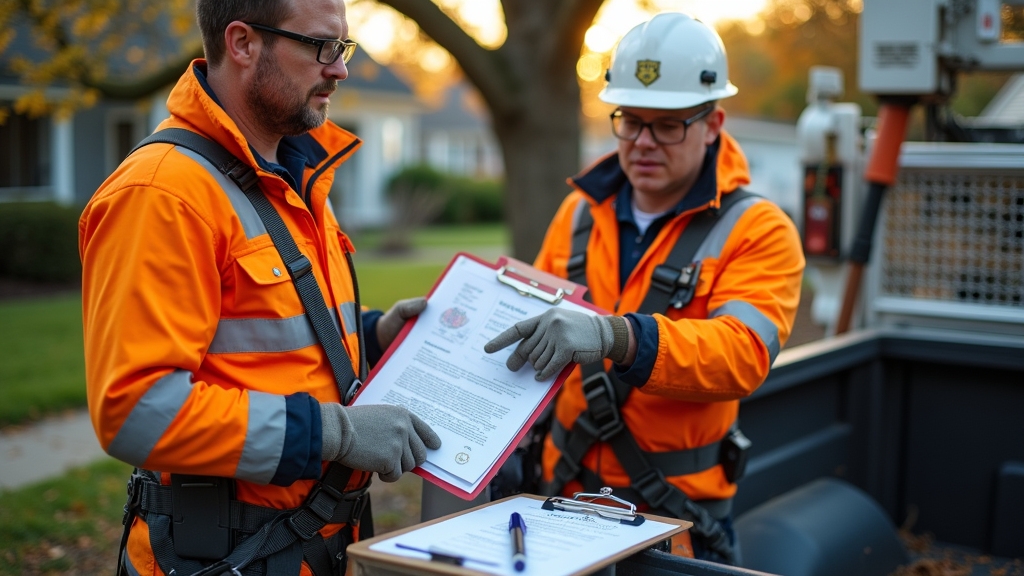
Before you hire anyone, confirm the company’s credentials: verify their business license, check for ISA-certified arborists on staff, and request proof of current general liability and workers’ compensation insurance.
Before hiring, verify licenses, ISA-certified staff, and active liability and workers’ compensation insurance.
Start with credential verification by matching the business name and license number to your state or municipal database. Ask for the ISA certification numbers and confirm them on the ISA website.
Request written documentation of active insurance policies, not just a verbal assurance. Call the insurer to confirm coverage limits and effective dates. Make sure workers’ compensation covers all employees who’ll be on your property.
Verify that the company’s name on the estimate matches the name on the license and insurance. If something doesn’t align, keep looking—gaps can become costly liabilities.
Prioritize Safety Standards and Equipment
Once you’ve verified credentials and insurance, focus on how the company works on-site. Ask about daily safety briefings, documented safety training, and who leads them.
A reliable crew wears helmets, eye and ear protection, chainsaw chaps, and uses proper rigging. They should set drop zones, use spotters, and manage traffic and power lines with clear communication.
Confirm their equipment maintenance routine. Well-kept chainsaws, climbing gear, and aerial lifts reduce breakdowns and injuries.
Ask how often ropes, saddles, and carabiners are inspected and retired. Look for recent maintenance logs and pre-job inspections.
Evaluate their emergency readiness. Do they have first-aid kits, CPR-trained staff, and a rescue plan for climbers?
If answers are vague, keep looking. Strong safety culture protects people, property, and trees.
Look for ISA Certification and Professional Affiliations
Even if a company looks capable, you’ll get better results by choosing one with ISA-certified arborists on staff. ISA certification signals rigorous training, tested knowledge, and adherence to industry standards.
Choose companies with ISA-certified arborists—proof of rigorous training, tested expertise, and industry-standard care.
It also means the arborist commits to continuing education, so they apply current best practices to your trees and landscape.
Ask directly: “Do you have ISA-certified arborists on every crew?” Then verify credentials on the ISA website.
Beyond ISA certification, check professional affiliations such as the Tree Care Industry Association (TCIA) or local arborist associations. These memberships often require codes of ethics, safety commitments, and ongoing professional development.
When you see credible professional affiliations alongside ISA certification, you reduce risk. You’re hiring pros who follow science-based methods, respect tree biology, and understand proper pruning, preservation, and risk assessment.
Compare Detailed, Written Estimates and Scope of Work
How can you tell if two bids cover the same work? Ask each company for a detailed, written scope and a clear cost breakdown.
Make certain the estimate lists tree species, size, location, and specific tasks: pruning types, removal methods, debris handling, stump grinding, and site protection. Note whether permits, traffic control, and utility coordination are included.
Do side-by-side service comparisons. Align line items so you’re evaluating equivalent labor, equipment, and safety measures.
Confirm who handles cleanup, hauling, and disposal fees. Check timing, crew size, and whether emergency surcharges or travel costs apply.
Verify if warranties, follow-up visits, and plant health care recommendations are part of the price.
Finally, make sure insurance and licensing statements appear on the estimate, and that payment terms and change-order procedures are explicit.
Check Reviews, References, and Past Project Results

Curiously, the fastest way to gauge a tree company’s reliability is to study its track record.
Start with online ratings on multiple platforms and look for consistent, recent feedback. Read customer testimonials for specifics: punctuality, cleanup, safety practices, and how crews handled surprises. Patterns matter more than one-off praise or complaints.
Scan multiple platforms for consistent, recent reviews—patterns in punctuality, cleanup, and safety reveal true reliability.
Ask for three local references and call them. Verify the scope, timeline, and final cost versus the quote. Confirm whether the crew used proper protective gear and protected nearby structures and landscaping.
Next, request before-and-after photos or addresses of past project sites similar to yours—storm-damaged removals, large pruning, or stump grinding.
Finally, check responses to negative reviews. Professional, solution-focused replies show accountability and a culture that values learning and customer care.
Frequently Asked Questions
How Do I Evaluate a Company’s Environmental and Tree-Health Practices?
Evaluate by asking for certifications, integrated pest management, and native species expertise. Review sustainability practices, waste recycling, and equipment emissions. Verify tree preservation policies, pruning standards, and soil care. Check references, before-after photos, and monitoring reports to confirm measurable, science-based results.
What Questions Should I Ask During the Initial Site Visit?
Ask about your tree species’ condition, risks, and long-term care. Request diagnostic methods, written estimates, timelines, and cleanup. Clarify pruning standards, soil care, and service options. Verify insurance, permits, crew qualifications, equipment sanitation, and how they protect nearby structures and wildlife.
How Can I Gauge Their Emergency Storm-Response Capabilities?
Ask for 24/7 availability, average response times, triage protocols, and crew mobilization size. Verify equipment readiness, mutual-aid partnerships, and communication methods. Request references from recent storm damage events, confirm insurance and permits, and review written contingency plans and priority lists.
Do They Offer Warranties or Guarantees on Pruning or Removals?
Yes—many do, but terms vary. Ask for written warranty details and specific service guarantees covering workmanship, timelines, cleanup, and post-service issues. Confirm duration, exclusions, transferability, and claim process. Request examples of honored claims to verify reliability.
How Are Neighbors and Property Boundaries Handled During Work?
You coordinate access, confirm boundaries, and document limits before work. Crews use site maps, flags, and permits, avoid encroachment, and clean debris. They promote neighbor communication to prevent property disputes, notify adjacent owners, and pause operations if conflicts arise until clarified.
Final Thoughts
Choosing the right tree care company is about protecting your property, investment, and peace of mind. By verifying credentials, insurance, and ISA certification, you ensure qualified professionals are on-site. Prioritize companies that maintain strong safety programs, follow ANSI A300 pruning standards, and provide detailed written estimates outlining scope, cleanup, and warranties. Reliable firms back their work with transparent communication, verified references, and proven results.
For dependable, fully insured service in Blue Island, trust Prime Tree Care, Inc. Our ISA-certified arborists deliver expert tree removal, tree pruning, stump grinding, and emergency tree service. Explore our full range of services and see why homeowners across Blue Island choose us for safe, affordable, and professional results.
Ready to hire a certified, trustworthy team? Request a detailed estimate today—contact Prime Tree Care for expert service backed by experience, insurance, and integrity.